


In some schools, growth and appraisal are experienced as isolated events. A formal observation is scheduled. Evidence is collected for the file. A rating is assigned. The process is completed and everyone moves on. In these systems, appraisal lives at the edges of school life. It documents practice, but it does little to develop it.
But growth and appraisal can do much more than that.
When designed well, growth and appraisal do not simply assess performance. They shape the way adults in a school think, work, collaborate, and improve together. They help establish what matters, how improvement happens, and what kinds of professional behaviors are expected and supported. In that sense, growth and appraisal are not just technical systems. They are school culture work.
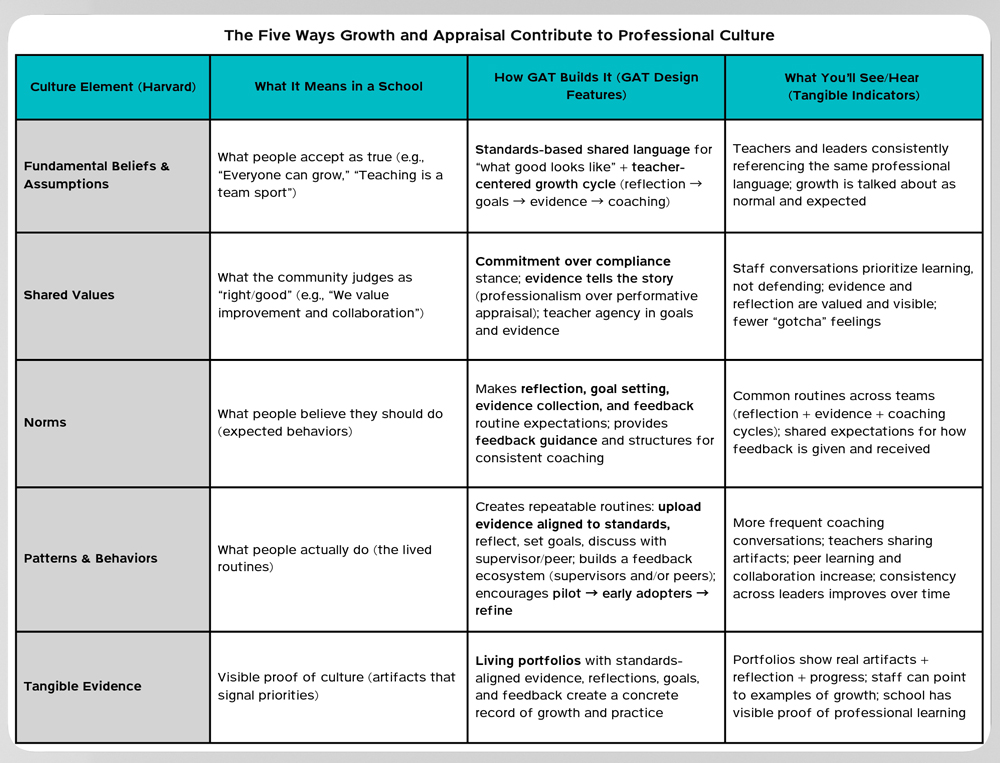
School culture is not built through slogans or posters on the wall. It is built through what people experience repeatedly. What Makes a Good School Culture? by Leah Shafer (Harvard Graduate School of Education) frames culture through five interrelated elements:
In this model, leaders are urged to ask what their community believes about the work, what it values, what rules or expectations guide behavior, what actions are consistently visible, and what tangible evidence reflects all of that.
This is where growth and appraisal deserves much more attention. If the system is built around one-time observations, top-down judgment, and paperwork completion, it teaches a culture of compliance. If it is built around standards, reflection, evidence, coaching, and ongoing dialogue, it helps create a culture of professional growth.
Schools need to shift from documentation to development.
The problem with observation-heavy systems is not that observation has no value. It is that observation alone is too thin a structure to build a strong professional culture. One formal lesson observation, or even a small number of supervisor observations, can only capture moments. It cannot by itself create shared habits of reflection, inquiry, feedback, and improvement over time. Even the research that supports multiple measures cautions against overconfidence in any single measure, especially for individual, high-stakes decisions. In their research paper, Have We Identified Effective Teachers?, Kane and colleagues found that student achievement gains, observations, and student surveys each capture different aspects of teaching, and they explicitly warned that a measure can be accurate on average while still being wrong for an individual teacher.
That has an important implication for culture. If a school’s growth and appraisal system is organized primarily around episodic supervisor judgment, teachers learn to perform for the event rather than engage in an ongoing process of improvement. The signal they receive is clear: what matters most is being seen positively, not learning publicly.
That is the opposite of the professional culture most schools say they want.
In my first article, Are Our Growth and Appraisal Systems Meeting Our Needs?, the research base made clear that teachers want feedback that is timely, trustworthy, grounded in multiple credible measures, and connected to student learning. Guskey and Link found that teachers most value feedback on student learning, feedback they trust in their own context, feedback they receive quickly, and feedback offered in meaningful, non-threatening ways. Those findings do not just tell us how to improve feedback. They tell us something larger about culture: teachers are more likely to grow in environments where improvement feels credible, supported, and normal.
So what would it look like to design growth and appraisal as part of culture building?
First, it would shape fundamental beliefs and assumptions.
A strong system helps establish a shared belief that good practice can be named, studied, and strengthened. Professional standards matter here, not as a checklist, but as a shared language for practice. Standards give schools a common way to talk about what effective teaching looks like and how it develops over time. When teachers are regularly reflecting on standards, setting goals against them, gathering evidence, and discussing practice in relation to them, the school begins to normalize an important assumption: everyone can grow, and growth is part of professional life. That is a cultural message, not just a procedural one.
Second, it would reinforce shared values.
Most traditional appraisal systems communicate that what matters is compliance: submitting forms, completing conferences, surviving observations, meeting deadlines. A more developmental system communicates different values. It says that teacher agency matters. Reflection matters. Evidence matters. Improvement matters. Professional dialogue matters. The center of gravity shifts from “Have you completed the process?” to “What are you learning about your practice, and what evidence shows that growth?”
That matters because values become real only when they are embedded in systems. A school cannot claim to value continuous improvement while operating an appraisal process that is primarily episodic, managerial, and rating-driven.
Third, it would establish norms for how adults work together.
Culture lives in repeated expectations. Over time, people learn what is normal in a school. Is it normal to talk openly about practice? Is it normal to share evidence of student learning? Is it normal to ask for feedback? Is it normal to collaborate with peers, not just report upward to supervisors?
This is where schools need to lower the walls around growth and appraisal. If feedback only moves from supervisor to teacher, then the system reinforces hierarchy more than learning. If growth is supported through peer conversation, collaborative reflection, shared evidence, coaching, and team-level professional dialogue, then the system begins to normalize a different way of working. Teachers are no longer isolated recipients of evaluation. They become active participants in a professional culture of improvement.
That does not remove the role of leadership. It strengthens it. Leaders still ensure clarity, calibration, and accountability. But they do so by building the conditions for adult learning across the school, not by positioning themselves as the sole owners of professional judgment.
Fourth, it would influence patterns and behaviors.
Culture is visible in routines. A system becomes culture-building when it creates repeatable habits that people actually use. Teachers set meaningful goals aligned to standards. They gather evidence across time, not just for an observation day. They reflect on what they are trying, what student evidence is showing, and what they may need to adjust. They engage in feedback conversations with supervisors and peers. They revisit goals and refine practice. Those repeated moves begin to form the behavioral pattern of the school.
This is one reason the shift away from one-time formal observation matters so much. One-time observation does not produce a strong pattern of professional learning. It produces an event. Culture, by contrast, is built through cycles.
And fifth, it would generate tangible evidence of growth.
Harvard’s framing includes a simple but powerful leadership question: what will be the tangible evidence of your beliefs, assumptions, values, norms, and behaviors? In a strong growth and appraisal system, the answer should be visible. It should exist in living portfolios, aligned evidence, reflections, goals, feedback records, coaching notes, and examples of changes in practice over time. These artifacts do more than prove that something happened. They make professional learning visible.
That visibility matters for individuals, but it also matters for the collective culture of a school. When growth is documented through meaningful evidence rather than compliance paperwork, schools can begin to see patterns across teams, departments, and divisions. They can identify shared strengths, common challenges, and emerging areas for professional learning. The system starts to contribute not just to individual appraisal, but to organizational learning.
That is when growth and appraisal becomes culture-building in the fullest sense. It helps a school create a shared truth about good practice, align adults around common values, normalize reflective and collaborative work, build routines for improvement, and produce visible evidence of professional learning.
Platforms such as TIE’s Growth and Appraisal Tool (GAT) can help make this kind of evidence visible and usable across a school.
And the stakes for getting this right are high. In their research, Chetty, Friedman, and Rockoff found that higher teacher value-added is associated with meaningful long-term outcomes for students, including higher college attendance, higher earnings, better college quality, lower rates of teenage parenthood, improved neighborhood quality, and higher participation in retirement savings. They estimated that a one standard deviation increase in teacher quality in a single grade raised earnings at age 28 by 1.3%. That is a reminder that improving teaching quality is not a marginal issue. It is one of the most important forms of school improvement work we do.
But teaching quality does not improve through compliance architecture. It improves when schools build cultures where professional growth is expected, supported, evidence-based, and sustained over time.
That is the opportunity in front of schools now. Not to make the old observation model slightly more efficient. Not to digitize paperwork. Not to add another layer of documentation. But to rethink growth and appraisal as one of the primary ways we shape adult culture in schools.
If the system is doing its job well, it should not just tell us how a teacher performed in a moment. It should help create a school where reflection is normal, evidence matters, feedback is useful, collaboration is expected, and growth is visible.
That is what makes growth and appraisal worth the effort.
References
Chetty, R., Friedman, J. N., & Rockoff, J. E. (2014). Measuring the impacts of teachers II: Teacher value-added and student outcomes in adulthood. American Economic Review, 104(9), 2633–2679.
Guskey, T. R., & Link, L. J. (2022). What teachers really want when it comes to feedback. Educational Leadership, 79(7), 42–48.
Kane, T. J., McCaffrey, D. F., Miller, T., & Staiger, D. O. (2013). Have we identified effective teachers? Validating measures of effective teaching using random assignment. Bill & Melinda Gates Foundation.
Harvard Graduate School of Education. (2018, September 9). Building a strong school culture.
Stacy Stephens is the Director of The International Educator (TIE) and has more than 25 years in international education as both a teacher and a school leader. In her work with TIE, she focuses on strengthening recruitment practices and helping educators show their impact through Evidence-Based Portfolios aligned to the Standards of Practice for International Schools. She also leads the development of TIE’s Growth and Appraisal Tool, which supports schools in building clearer, more supportive systems for feedback, development, and professional growth, always with a focus on better outcomes for students and healthier school cultures.